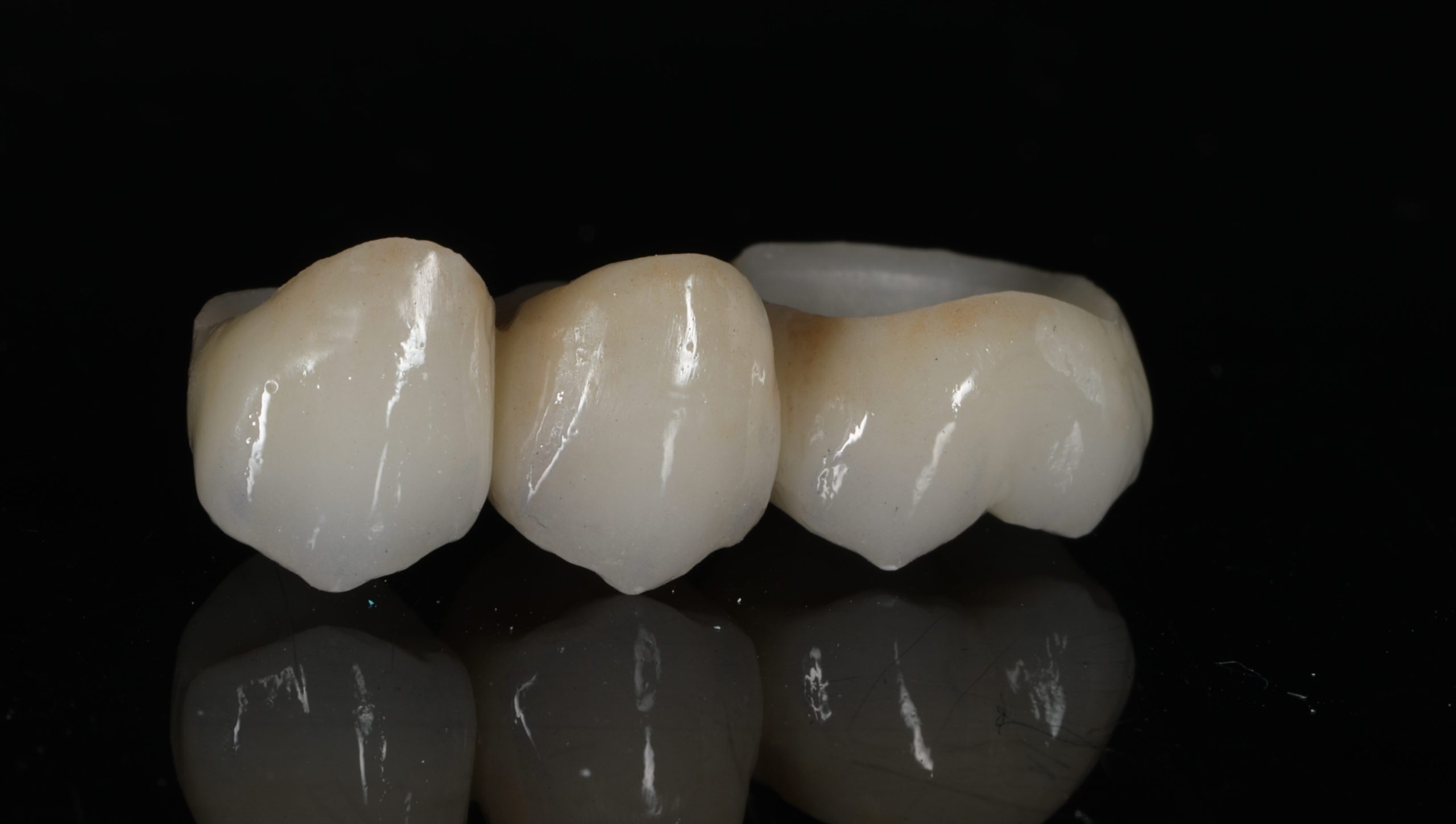
Zirconia bridges have become an important option for dentists looking for a combination of strength, durability, and natural-looking esthetics. Modern zirconia materials have also evolved significantly. Today, multilayer zirconia can provide a much more natural appearance than the earlier generations of traditional opaque zirconia.
For dental practices restoring missing teeth, zirconia dental bridges can provide a strong and highly versatile restorative solution for both posterior and selected anterior cases.
A zirconia bridge is a fixed dental prosthesis fabricated from zirconium dioxide, a high-strength ceramic material. Unlike traditional metal-based bridges, zirconia bridges are metal-free and can be designed entirely from ceramic.
Zirconia can be used for a variety of fixed restorations, including:
The appropriate zirconia design and material should always be selected according to the individual clinical situation, span, connector dimensions, occlusion, preparation design, and manufacturer’s indications.
One of the main reasons dentists choose zirconia for bridges is its combination of high strength and ceramic esthetics.
A dental bridge must withstand significant functional forces during chewing. Zirconia’s mechanical properties make it particularly useful when a restoration requires high resistance to fracture.
This can make zirconia an attractive option for posterior dental bridges, where functional loads can be substantial.
The laboratory design remains critical, however. Material strength alone does not guarantee a successful restoration. Connector dimensions, framework design, occlusal contacts, preparation geometry, material thickness, and sintering protocol all contribute to the performance of a zirconia bridge.
Modern multilayer zirconia has changed the way zirconia restorations can look.
Earlier generations of zirconia were often relatively monochromatic and could appear more opaque than natural teeth. Modern multilayer zirconia materials incorporate different levels of chroma and translucency within the same disc.
During CAD/CAM production, the restoration can be positioned within the multilayer zirconia disc so that the final crown or bridge transitions through different shades and translucency levels.
This creates a more natural color gradient from the cervical area toward the incisal portion of the restoration.
The result can be a zirconia bridge with significantly more depth and visual variation than a traditional single-shade monolithic restoration.
Traditional monolithic zirconia is manufactured from a single zirconia material and can provide excellent strength and durability.
Multilayer zirconia takes the concept further by incorporating different optical characteristics throughout the material.
Depending on the specific zirconia system, multilayer materials can provide variations in:
This allows the dental technician to create a restoration that looks more similar to the natural progression of color and translucency found in a tooth.
The availability of multilayer zirconia gives dentists and dental laboratories more flexibility when selecting materials for different cases.
For posterior zirconia bridges, strength and functional design are often major considerations. Full-contour or multilayer zirconia can provide a combination of strength and improved optical properties.
For anterior zirconia bridges, optical characteristics become particularly important. The laboratory can use the multilayer structure together with surface characterization, staining, polishing, or ceramic layering when appropriate to achieve the desired esthetic result.
The ideal approach depends on the patient’s dentition, shade requirements, occlusion, preparation, bridge design, and clinical objectives.
One of the biggest advantages of modern zirconia is that dentists no longer have to think of zirconia simply as a “strong but opaque” material.
Today’s zirconia materials offer a broad range of strength, translucency, and esthetic options.
A properly designed multilayer zirconia bridge can combine:
Strength + durability + natural color transitions + improved translucency + metal-free esthetics.
This makes zirconia an increasingly versatile material for fixed dental restorations.
Even the most advanced zirconia material depends on proper CAD/CAM design and laboratory fabrication.
For a zirconia bridge, the dental laboratory must consider the span, connector dimensions, pontic design, occlusion, contacts, material thickness, preparation geometry, and the specific manufacturer’s requirements.
The digital workflow also allows the dental technician to carefully control the morphology and position of the restoration before milling.
After milling and sintering, additional characterization and finishing can be performed when indicated.
At Grin Dental Lab in San Francisco, we fabricate custom zirconia restorations for dentists who are looking for a combination of strength, precision, and natural esthetics.
Our zirconia workflow includes multilayer zirconia crowns and bridges, monolithic zirconia restorations, esthetic zirconia, posterior zirconia restorations, and complex fixed prosthetic cases.
We work directly with dentists to understand the clinical requirements of each case and select the appropriate design and ceramic approach.
For dentists in San Francisco and the Bay Area looking for a dental laboratory for zirconia bridges, zirconia crowns, implant restorations, and complex ceramic cases, Grin Dental Lab provides personalized laboratory support and communication throughout the case.
Zirconia continues to evolve, and multilayer zirconia represents an important step forward in combining the mechanical advantages of zirconia with improved optical characteristics.
For the right clinical case, a modern zirconia bridge can provide an excellent combination of strength, function, durability, and esthetics.